10 Free Websites That Feel Illegal To Know (But Actually Aren't)
Discover 10 powerful free learning resources that can transform your education and career. From MIT courses to Harvard lectures, from AI training to millions of free books - these websites offer world-class knowledge at zero cost.
Unlock World-Class Education Without Spending a Dime
Here's something that might surprise you: some of the world's most prestigious institutions are quietly giving away their knowledge for free. We're talking about universities that normally charge $50,000+ per year in tuition, tech giants that spent billions developing their platforms, and organizations that have accumulated centuries of human knowledge.
The internet has democratized access to information in ways that would have seemed impossible just two decades ago. Today, a curious teenager in a small town has access to the same world-class educational resources as students at elite universities. The barrier isn't access anymore—it's knowing where to look.
In this comprehensive guide, we've curated 10 incredible free websites that offer such tremendous value, they almost feel too good to be true. From complete university courses to millions of free books, from AI training materials to professional skill certifications—these resources can genuinely transform your career and knowledge base without costing you anything except time and dedication.
🔑 The Real Secret to Free Learning
These platforms exist because education-focused organizations, tech companies with social missions, and public institutions believe knowledge should be accessible to everyone. They're funded through donations, advertising, premium features for enterprise users, or government support. Your access is intentionally free—take advantage of it.
FreeLearningList
Master Index of Free Education Resources Across the Internet
Think of FreeLearningList as your personal GPS for free education. Instead of spending hours searching for legitimate free courses scattered across the web, this curated directory aggregates all the best free learning resources in one place. Simply pick a skill you want to develop, and it shows you exactly where to learn it—completely free.
The beauty of this resource lies in its curation. The internet is filled with dubious "free" courses that turn out to be sales funnels. FreeLearningList does the vetting for you, featuring only genuinely free, high-quality learning materials from reputable sources. Whether you want to learn data science, graphic design, foreign languages, or business fundamentals, there's a verified path waiting for you.
🎯 What You Can Learn
- Programming & Development: Python, JavaScript, web development, mobile apps
- Data & Analytics: Data science, machine learning, SQL, visualization
- Business Skills: Marketing, finance, project management, entrepreneurship
- Creative Skills: Design, photography, video editing, music production
- Languages: Spanish, Mandarin, French, and dozens more
💰 Cost: Completely FREE. This is a directory service pointing you to free resources across the web.
Best For: Anyone starting their self-education journey who doesn't know where to begin. Perfect for career changers, students supplementing their education, and lifelong learners.
Visit FreeLearningListGoogle Skills Boost
Learn Cloud Computing, AI & Data Skills from Google Engineers
When Google decides to train the next generation of tech professionals, they don't hold back. Google Skills Boost (formerly Qwiklabs and Google Cloud Skills Boost) offers hands-on training in some of the most in-demand skills in the tech industry: cloud computing, artificial intelligence, machine learning, and data engineering.
What makes this platform special isn't just the content—it's the hands-on learning approach. You get access to real Google Cloud environments where you can practice building actual applications, deploying machine learning models, and managing cloud infrastructure. This isn't theoretical learning; you're working with the same tools used by companies like Spotify, Snapchat, and Twitter.
Google regularly offers free access periods and promotional credits. Many learning paths are completely free, and completing them earns you Google Cloud skill badges that you can display on your LinkedIn profile—valuable credentials that hiring managers actively look for.
🎯 Key Learning Paths
- Cloud Fundamentals: Learn cloud computing from the ground up
- Data Engineering: Build data pipelines and analytics solutions
- Machine Learning: Train and deploy ML models using Google's tools
- Cybersecurity: Security fundamentals for cloud environments
- Digital Marketing: Google Ads, Analytics, and digital strategy
💰 Cost: Many courses and learning paths are FREE. Some advanced labs require credits, but Google frequently offers free credit promotions.
Best For: Tech professionals looking to upskill, developers wanting to learn cloud computing, and anyone interested in AI/ML careers. The certifications carry real weight in job applications.
Visit Google Skills BoostMIT OpenCourseWare
2,500+ MIT Courses with Complete Materials - Totally Free
In 2001, MIT made a decision that changed online education forever: they would publish virtually all of their course materials online, free for anyone in the world to access. No registration required. No fees. No catch. Today, MIT OpenCourseWare hosts over 2,500 courses covering everything from quantum physics to medieval history.
This isn't watered-down content—these are the actual lecture notes, problem sets, exams, and video lectures used by MIT students. The same materials that students pay $55,000+ per year to access are available to you right now. Courses include full video lectures, readings, assignments, and often even past exams with solutions.
What's particularly valuable for self-learners is the structured approach. Each course provides a clear syllabus, prerequisite recommendations, and a logical progression through the material. You can essentially recreate an MIT education from your laptop, learning at your own pace.
🎯 Popular Course Categories
- Computer Science: Introduction to Algorithms, AI, Machine Learning
- Mathematics: Calculus, Linear Algebra, Probability
- Physics: Classical Mechanics, Quantum Physics, Relativity
- Economics: Microeconomics, Game Theory, Financial Markets
- Engineering: Electrical, Mechanical, Aerospace disciplines
💰 Cost: 100% FREE. All 2,500+ courses are openly available. No registration required for most content.
Best For: Self-motivated learners who want rigorous, university-level education. Excellent for students preparing for advanced degrees or professionals wanting deep knowledge in technical fields.
Visit MIT OpenCourseWareKhan Academy
World-Class Education for Anyone, Anywhere - Always Free
What started as Sal Khan tutoring his cousins through YouTube videos has evolved into one of the most important educational platforms in human history. Khan Academy serves over 120 million registered users worldwide, providing free, world-class education to anyone with internet access.
The platform's strength lies in its mastery-based learning approach. Rather than rushing through topics, Khan Academy ensures you truly understand each concept before moving on. Interactive exercises provide instant feedback, and the platform adapts to your learning pace. Struggling with fractions? It'll provide more practice. Breezing through algebra? It'll challenge you with harder problems.
While Khan Academy started with math, it now covers an impressive range of subjects from SAT prep to art history, from personal finance to computer programming. The content is particularly strong for foundational subjects—if you need to brush up on math basics or finally understand economics, this is your go-to resource.
🎯 Subject Coverage
- Mathematics: From basic arithmetic to multivariable calculus
- Science: Biology, chemistry, physics, organic chemistry
- Economics: Micro, macro, and personal finance
- Computing: HTML/CSS, JavaScript, SQL basics
- Test Prep: SAT, LSAT, MCAT, and more
💰 Cost: 100% FREE. Khan Academy is a nonprofit funded by donations and will never charge for content.
Best For: Students of all ages, from elementary to college. Perfect for filling knowledge gaps, preparing for standardized tests, or learning foundational subjects you missed in school.
Visit Khan AcademyHarvard Free Online Courses
Ivy League Education from Harvard University - Free Access
Harvard University—the name alone carries weight on any resume. Founded in 1636, it's produced 8 U.S. presidents, 188 billionaires, and countless leaders across every field. And now, through their online learning initiative, Harvard offers over 100 free courses to anyone in the world.
These courses are taught by the same professors who teach on Harvard's campus. You'll learn from renowned experts who've written the textbooks used in universities worldwide. The quality isn't diluted—this is genuine Harvard education delivered through video lectures, readings, and interactive assignments.
The most popular course, CS50: Introduction to Computer Science, has enrolled over 4 million students. It's considered one of the best introductions to computer science ever created, and it's completely free. Other standout offerings include courses on justice, philosophy, data science, and public health.
🎯 Featured Free Courses
- CS50: Harvard's legendary introduction to computer science
- Justice: One of the most popular courses in Harvard's history
- Data Science: Professional Certificate in Data Science
- Public Health: Epidemiology and biostatistics courses
- Business: Entrepreneurship and management essentials
💰 Cost: Course content is FREE. Optional verified certificates available for $50-$200 if you want formal credentials.
Best For: Anyone who wants to experience Ivy League education. Particularly valuable for those exploring new fields, professionals seeking to upskill, or curious minds who want the best instruction available.
Visit Harvard Free CoursesCoursera (Audit Mode)
Access 7,000+ Courses from Top Universities for Free
Here's something most people don't realize: Coursera lets you access most courses completely free through their "Audit" mode. While Coursera heavily promotes their paid subscriptions and certificates, the core learning content—video lectures, readings, and community forums—is available at no cost.
The trick is knowing how to find it. When you enroll in a course, look for the small "Audit" link (sometimes hidden as "full course, no certificate"). This gives you access to all video lectures and readings. You won't get graded assignments or a certificate, but if your goal is learning rather than credentials, you're getting 90% of the value for 0% of the cost.
Coursera partners with over 275 universities and companies including Stanford, Yale, Google, IBM, and Meta. The course catalog is massive—over 7,000 courses covering virtually every subject imaginable. From machine learning fundamentals to creative writing to financial planning, there's something for everyone.
🎯 Top Partner Institutions
- Stanford University: Machine Learning, Algorithms, Cryptography
- Yale University: Financial Markets, Psychology, Science of Well-Being
- Google: IT Support, Data Analytics, UX Design
- University of Michigan: Python for Everybody, Web Development
- IBM: AI Engineering, Data Science, Cloud Computing
💰 Cost: Audit mode is FREE for most courses. Paid options ($39-$79/course or $59/month subscription) add certificates and graded assignments.
Best For: Lifelong learners who want access to top university courses. Great for exploring new fields before committing to formal education or supplementing current studies.
Visit CourseraProject Gutenberg
70,000+ Free Ebooks Including Literary Classics
Before Google, before Amazon, before the modern internet even existed, Project Gutenberg was digitizing books and making them freely available. Founded in 1971, it's the oldest digital library in the world and remains one of the most valuable resources for readers and researchers alike.
The collection focuses on works in the public domain—books whose copyrights have expired. This includes literary classics by Shakespeare, Dickens, Austen, Twain, and thousands of other authors. But it goes far beyond fiction: you'll find philosophical treatises, historical documents, scientific papers, and reference works spanning centuries of human knowledge.
Books are available in multiple formats (EPUB, Kindle, HTML, plain text) so you can read on any device. There's no registration required, no limits on downloads, and no DRM restrictions. This is what digital libraries should be—open, accessible, and free.
🎯 What You'll Find
- Classic Literature: Works by Shakespeare, Tolstoy, Dickens, Austen
- Philosophy: Plato, Aristotle, Nietzsche, Kant
- Science: Darwin, Newton, Einstein's original papers
- History: Primary source documents, historical accounts
- Reference: Encyclopedias, dictionaries, textbooks
💰 Cost: 100% FREE. All 70,000+ ebooks are freely available with no registration required.
Best For: Book lovers, students studying literature or history, researchers, and anyone who wants to build a digital library of classics without spending money.
Visit Project GutenbergOpen Library
Borrow Millions of Books Online Like a Digital Library Card
Imagine having a library card that works at every library in the world simultaneously. That's essentially what Open Library offers. This project from the Internet Archive provides free borrowing of millions of ebooks—including modern, copyrighted titles that you'd normally have to purchase.
The concept is called "Controlled Digital Lending." Open Library owns physical copies of books and lends out digital versions in a one-to-one ratio, just like a traditional library. You can borrow books for 14 days, read them in your browser or download for offline reading, and return them when you're done (or they automatically return).
Unlike Project Gutenberg's public domain focus, Open Library includes contemporary books—bestsellers, recent nonfiction, textbooks, and more. Combined with their collection of older public domain works, it's an incredibly comprehensive resource for readers.
🎯 Library Features
- Modern Books: Borrow contemporary titles, bestsellers, and new releases
- Multiple Formats: Read online, download EPUB, or read in Kindle
- Personal Reading Lists: Save books and track reading progress
- Book Reviews: Community ratings and reviews
- Author Pages: Complete bibliographies for millions of authors
💰 Cost: FREE with account registration. Borrow up to 10 books at a time for 14-day periods.
Best For: Avid readers who want access to both classic and modern books. Essential for students needing textbooks, researchers, and anyone who loves reading but doesn't want to pay for every book.
Visit Open LibraryInternet Archive
The Digital Memory of Human Civilization - 702 Billion Web Pages & More
The Internet Archive is one of humanity's most ambitious projects: an attempt to preserve the entirety of digital human knowledge. Founded in 1996, it now contains over 702 billion web pages, 41 million books, 14.7 million audio recordings, 8.4 million videos, and millions of images and software programs.
The famous Wayback Machine lets you explore historical snapshots of any website. Want to see what Google looked like in 1998? What news sites reported on 9/11? How your favorite website evolved over decades? It's all preserved here. This alone makes it an invaluable resource for researchers, journalists, and the curious.
But the Archive goes far beyond web pages. You'll find old video games you can play in your browser, vintage software, classic films, TV shows, live concert recordings, radio broadcasts, academic papers, magazines, and more. It's like having access to humanity's attic—full of treasures most people don't know exist.
🎯 What's in the Archive
- Wayback Machine: 702+ billion saved web pages from 1996-present
- Books: 41 million texts including rare historical documents
- Audio: Live music, radio shows, podcasts, audiobooks
- Video: Classic films, TV shows, documentaries
- Software: Vintage games and applications playable in-browser
💰 Cost: FREE. The Internet Archive is a nonprofit dedicated to universal access to knowledge.
Best For: Researchers, historians, journalists, and curious minds who want to explore digital history. Also great for finding out-of-print media, vintage software, and historical content.
Visit Internet ArchiveOpenAI Learn (AI Academy)
Learn AI from the Creators of ChatGPT - Free Courses
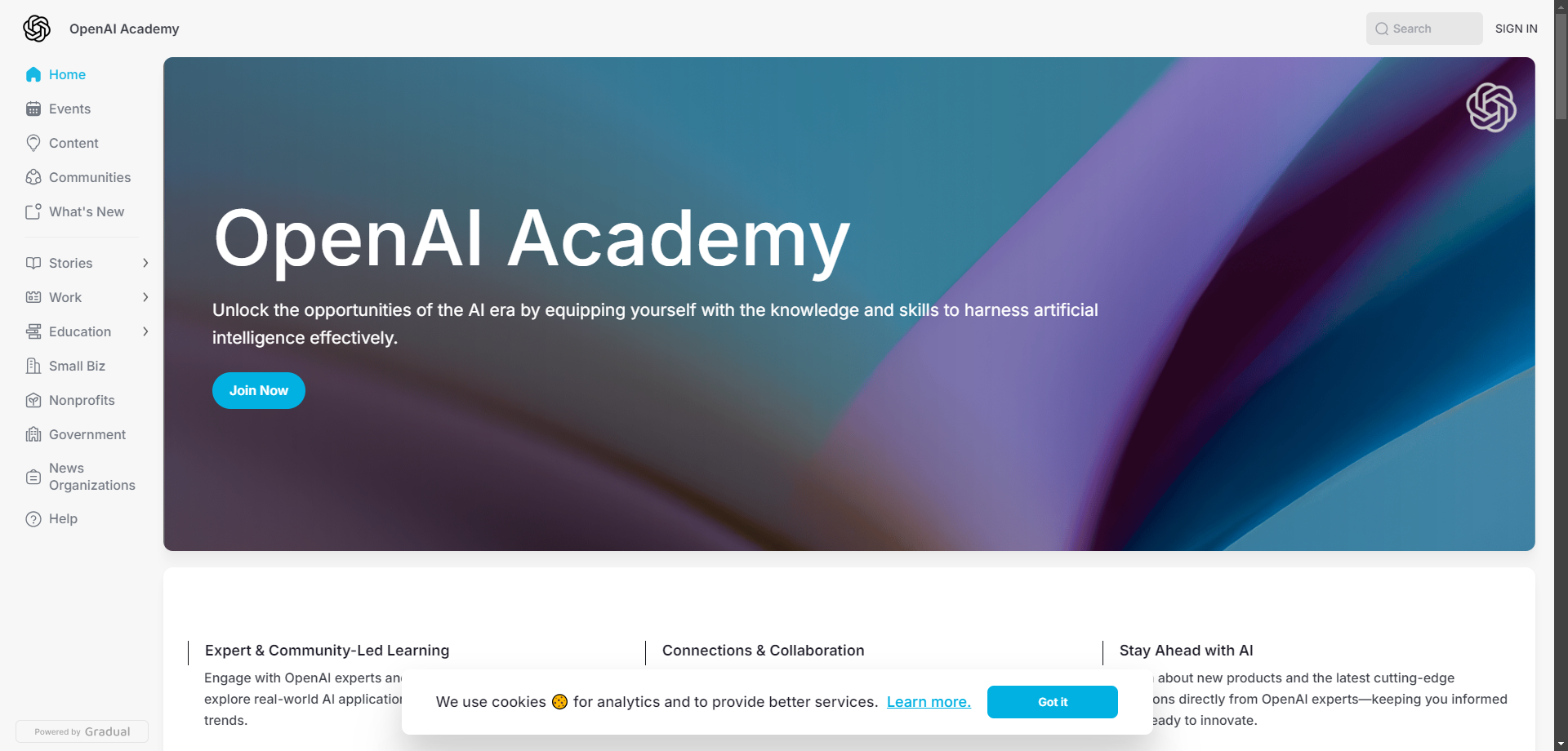
Who better to teach you about AI than the company that created ChatGPT? OpenAI's learning platform provides free courses designed to help you actually use AI effectively—not just understand it theoretically, but apply it to real-world problems in your work and life.
Unlike academic AI courses that focus on mathematics and theory, OpenAI Learn takes a practical, hands-on approach. You'll learn prompt engineering techniques, workflow optimization strategies, API integration basics, and real use cases across different professions. Whether you're a marketer, developer, writer, or business professional, there's content tailored to your needs.
The platform includes the recently launched AI Academy with 11 free courses covering everything from basics to advanced prompting. As AI continues to reshape industries, understanding how to leverage these tools effectively is becoming one of the most valuable skills in the job market.
🎯 Learning Topics
- Prompt Engineering: Master the art of communicating with AI
- ChatGPT Best Practices: Get more out of conversations
- API Fundamentals: Build applications with OpenAI's API
- Industry Applications: AI use cases for different professions
- Safety & Ethics: Responsible AI usage guidelines
💰 Cost: FREE courses and learning materials. Some advanced certifications may have fees.
Best For: Anyone wanting to become more effective with AI tools. Essential for professionals who want to stay competitive as AI transforms their industry.
Visit OpenAI AcademyWhy Are These Resources Free?
You might wonder: what's the catch? Here's the truth about why these valuable resources don't cost anything:
🎓 Educational Mission
Universities like MIT and Harvard believe knowledge should be accessible. Their free offerings spread their educational impact globally while enhancing their prestige.
💼 Corporate Investment
Companies like Google offer free training because they need skilled workers. Training you for free creates a pipeline of talent familiar with their tools.
🏛️ Nonprofit Missions
Organizations like Khan Academy and Internet Archive are nonprofits funded by donations. Their explicit purpose is providing free access to knowledge.
💰 Freemium Models
Platforms like Coursera offer free content because some users convert to paid certificates. Your free access is subsidized by those who choose to pay.
How to Maximize These Free Resources
📅 Create a Learning Schedule
Free doesn't mean unstructured. Treat these courses like a real class—set specific times, take notes, and complete assignments even if they're not graded.
🎯 Focus on One Thing at a Time
With so many options, it's tempting to start multiple courses. Instead, complete one course fully before moving to the next. Depth beats breadth.
📝 Build a Portfolio
Document what you learn. Create projects, write summaries, build a portfolio. Self-directed learning counts when you can demonstrate the skills you've gained.
👥 Join Learning Communities
Most platforms have forums or communities. Engage with other learners, ask questions, and help others. Teaching reinforces your own understanding.
Frequently Asked Questions
The Only Thing Standing Between You and Knowledge Is Action
We live in an unprecedented era. The same education that was once reserved for the privileged few is now available to anyone with internet access. MIT's courses, Harvard's lectures, Google's training programs, millions of books—all free, all waiting for you.
The real question isn't whether you can afford an education—it's whether you're willing to invest the time and effort to pursue one. These resources have already changed millions of lives. Students in developing countries have used them to win jobs at top tech companies. Career changers have used them to pivot into entirely new fields. Curious minds have used them to explore subjects they never had access to before.
Pick one site from this list. Start today. Not tomorrow, not next week—today. Because the only real advantage isn't just knowing these resources exist. It's being one of the few who actually uses them.